
Every week I speak with parents who are sitting across from a school administrator, holding a document they've never seen before, being asked to sign something they don't fully understand.
Sometimes it's an IEP. Sometimes it's a 504 Plan. Often, parents don't know the difference between the two — and more importantly, they don't know which one their child actually needs.
I've been navigating these systems for over 30 years, first as a parent myself, and then professionally as an advocate for hundreds of families. What I've learned is that the confusion isn't your fault. These documents use legal and clinical language that wasn't designed to be accessible. And schools — even well-meaning ones — don't always take the time to explain them properly.
This guide is my attempt to change that.
An IEP or 504 Plan is a legal document — and like any legal document, the details matter enormously. Understanding what you're agreeing to is the first step to using it strategically.
First: What both plans have in common
Both an IEP and a 504 Plan are legal documents designed to support students with disabilities in accessing their education. Both require the school to provide specific accommodations or services. And both require parental involvement and consent.
That's roughly where the similarities end.
What is an IEP?
An IEP — Individualized Education Program — is a comprehensive, legally binding document created under IDEA (the Individuals with Disabilities Education Act). It's developed for students who have a documented disability that falls into one of 13 specific categories and that directly affects their ability to make progress in a general education setting.
The key word is individualized. An IEP doesn't just provide accommodations — it prescribes specialized instruction, measurable annual goals, and often related services like speech therapy, occupational therapy, or counseling. It's a whole plan for how a child will be taught, not just how they'll be tested.
Common IEP categories include:
• Specific learning disability (dyslexia, dyscalculia, dysgraphia)
• Autism spectrum disorder
• Emotional disturbance
• Other health impairment (including ADHD, when it significantly affects performance)
• Intellectual disability
• Speech or language impairment
• Developmental delay (for younger children)
An IEP is developed by a formal team that includes parents, general education teachers, special education staff, a school psychologist, and an administrator. It's reviewed at least annually and can be revised at any time.
Importantly, the school is legally required to implement everything in an IEP. If they don't, parents have legal recourse.
What is a 504 Plan?
A 504 Plan operates under a different law — Section 504 of the Rehabilitation Act — and has a broader definition of disability. A student qualifies if they have any physical or mental impairment that substantially limits a major life activity, including learning, concentrating, reading, or thinking.
Unlike an IEP, a 504 Plan doesn't provide specialized instruction. It provides accommodations — changes to the environment or testing conditions that allow a student equal access to the general curriculum. Think extended time on tests, preferential seating, reduced homework load, or access to a quiet testing room.
504 Plans are generally less formal to create. They don't require the same team, the same documentation, or the same annual review process. And while they are legally enforceable, the process for challenging violations is less structured than under IDEA.
Common 504 accommodations include:
• Extended time on tests and assignments
• Preferential seating (near the front, away from distractions)
• Access to a quiet testing environment
• Copies of notes or teacher outlines
• Chunked assignments or reduced written output
• Frequent check-ins from teachers
• Permission to use assistive technology
Side-by-side comparison
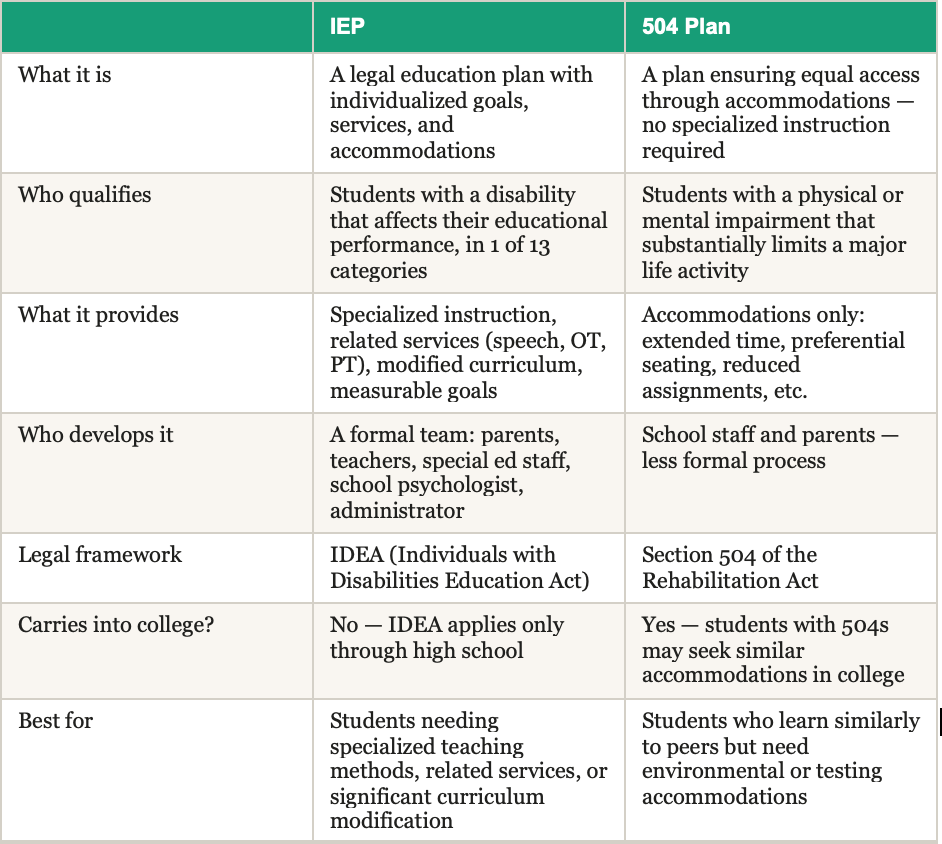
IEP
What it is
A legal education plan with individualized goals, services, and accommodations
Who qualifies
Students with a disability that affects their educational performance, in 1 of 13 categories
What it provides
Specialized instruction, related services (speech, OT, PT), modified curriculum, measurable goals
Who develops it
A formal team: parents, teachers, special ed staff, school psychologist, administrator
Legal framework
IDEA (Individuals with Disabilities Education Act)
Carries into college?
No — IDEA applies only through high school
Best for
Students needing specialized teaching methods, related services, or significant curriculum modification
504 Plan
What it is
A plan ensuring equal access through accommodations — no specialized instruction required
Who qualifies
Students with a physical or mental impairment that substantially limits a major life activity
What it provides
Accommodations only: extended time, preferential seating, reduced assignments, etc
Who develops it
School staff and parents — less formal process
Legal framework
Section 504 of the Rehabilitation Act
Carries into college?
Yes — students with 504s may seek similar accommodations in college
Best for
Students who learn similarly to peers but need environmental or testing accommodations
Which does your child need?
This is the question I'm asked most often, and the honest answer is: it depends on what your child actually needs — not what's easier for the school to provide.
Schools sometimes offer a 504 when a child should have an IEP. Not out of malice — but because an IEP requires significantly more resources. Knowing the difference means you can advocate more effectively.
Here's a rough framework I use with families:
Your child may need an IEP if:
• They are performing significantly below grade level and aren't catching up with standard support
• They need a fundamentally different teaching approach, not just more time
• They require related services like speech therapy, OT, or counseling as part of their school day
• Their disability affects how they process and produce information, not just how they're tested
• They need measurable, documented progress toward specific skill goals
Your child may need a 504 if:
• They learn similarly to their peers but need environmental adjustments to access learning equally
• Their primary challenge is around testing conditions, organization, or attention management
• They've been diagnosed with ADHD, anxiety, or a physical condition that requires accommodations but not specialized instruction
• They're performing close to grade level with the right supports in place
• They plan to attend college, where 504-equivalent accommodations are available but IEP services are not
If you're unsure, the most important thing is to request a full evaluation in writing. Under both IDEA and Section 504, you have the right to request that the school evaluate your child — and the school cannot legally deny this request without providing written justification.
What parents often miss
In my experience, families frequently make three mistakes in this process:
1. Accepting what the school offers without questioning it
Schools are not adversaries — but they are resource-constrained. A 504 is faster and cheaper to implement than an IEP. If your child qualifies for an IEP but the school offers a 504, it's worth asking directly: "Based on the evaluation results, does my child meet the criteria for an IEP?" Then get the answer in writing.
2. Signing documents at the meeting
You are never required to sign an IEP or 504 Plan at the meeting where it's presented. You can — and often should — ask to take it home, review it carefully, and return it within a few days. This is especially true for IEPs, which contain legal commitments from the school.
3. Treating the document as permanent
Both plans can be revised. If your child's needs change — if they're making less progress than expected, if a new diagnosis changes the picture, or if a service isn't being delivered — you can request a meeting to revisit the plan at any time. Don't wait for the annual review if something isn't working.
Your rights as a parent — a quick reminder
Under IDEA and Section 504, you have the right to:
• Request a free, comprehensive evaluation at any time — in writing
• Receive a copy of all evaluation results and reports
• Participate fully in IEP and 504 meetings
• Disagree with the school's findings and request an independent evaluation
• Refuse consent for evaluations or services
• Request mediation or file a complaint if the school isn't fulfilling its obligations
If you've never been told these things explicitly, you're not alone. Most parents haven't.
When to bring in an advocate
Most families can navigate the initial IEP or 504 process on their own — especially when their school is communicative and responsive. But there are situations where having an experienced advocate in the room changes the outcome significantly.
Consider reaching out when:
• Your child has been evaluated but the school is disputing the results or downplaying the findings
• You've requested services that the school is denying — and you're not sure if the denial is appropriate
• Your child has an IEP but isn't making expected progress and the school isn't sure why
• You're navigating a placement decision — moving your child to a different school or considering a more specialized setting
• The meetings feel adversarial and you're not sure what you can push back on
• Your child's needs are complex and span multiple areas (learning, emotional, behavioral)
An advocate's job isn't to antagonize the school — it's to make sure the right questions get asked, the right data is on the table, and your child's legal rights are being honored. We've sat in hundreds of these meetings. We know what language the school is required to use, what services they're required to offer, and when a "we can't do that" is actually "we'd prefer not to."
A final note — from one parent to another
Navigating the special education system is genuinely hard. The paperwork is dense, the meetings can feel intimidating, and the stakes are high — because you're not just making a bureaucratic decision. You're deciding how your child learns, and what support they're entitled to.
What I want every parent to know is this: you are your child's most important advocate. Not because the school doesn't care — often they do — but because you know your child in a way no administrator ever will. The system works better when parents are informed, engaged, and unafraid to ask hard questions.
That's what we're here to help you do.
You don't have to understand every line of an IEP to show up as a powerful advocate for your child. You just need to know your rights, trust what you're seeing, and be willing to ask for more when more is needed.
Need help navigating your child's IEP or 504 Plan?
Liston Education Group provides special education advocacy services — from reviewing existing plans to representing families in IEP meetings to helping parents understand what their child is entitled to under the law.
We work with families across the country, in person and remotely.
Reach out to schedule a consultation. There's no intake form — just a conversation about your child and where things stand.
About the author
Jodi Liston is the founder of Liston Education Group, a concierge educational and therapeutic consulting firm. She has spent more than 30 years helping families navigate complex academic, emotional, and behavioral challenges — including special education advocacy, school placement, therapeutic program placement, and crisis intervention. She came to this work in part through her own experience as a parent navigating these systems, and that experience shapes every family she works with.