
Boarding School in 2026: Who It's Actually For, and How to Know If It's Right for Your Child
When most parents hear the words "boarding school," one of two images comes to mind.
The first: a sprawling New England campus, blazers and traditions, the preserve of families with generational wealth and children whose path to the Ivy League was paved at birth.
The second: a last resort. A place where families send children they don't know what to do with — a remove-the-problem solution dressed up in academic language.
After more than 30 years of placing students in boarding schools of every kind, I can tell you that both images are incomplete. And the gap between what people imagine boarding school to be and what it actually is has cost a lot of children an environment where they might have thrived.
This guide is my attempt to close that gap; to give families an honest, current picture of what the boarding school landscape actually looks like, who it genuinely serves, and how to think about whether it might be the right direction for your child.
The boarding school landscape is far wider, more diverse, and more accessible than most families realize. The question has never been whether your child is "the type" for boarding school. It's whether there's an environment within that landscape that fits who they are.
Let's start with what boarding school is… and isn't
Boarding school, at its most basic, is a school where students live as well as study. The residential component is what distinguishes it from a day school, and it's the component that tends to carry the most assumptions.
People assume boarding school means separation, and that separation means something is wrong. But for many students, the residential component is precisely what makes the experience work. Living within a structured community, with consistent peers, adults present at all hours, and a daily rhythm that extends beyond the classroom, creates conditions that produce growth some students simply can't access at home.
What boarding school is not: a solution you apply to a child who is struggling and hope the environment does the work. For some students, boarding school is the right environment for academic, social, and personal growth. For others, particularly those with significant clinical needs, the right environment is a therapeutic boarding school, which is a different category entirely.
Understanding the distinction between these two things is where most families need to start.
The modern boarding school landscape: far wider than you think
There is no single "boarding school." There is a landscape of hundreds of schools, each with a distinct culture, academic approach, population, and purpose. Let me walk you through the main categories and who each one serves:
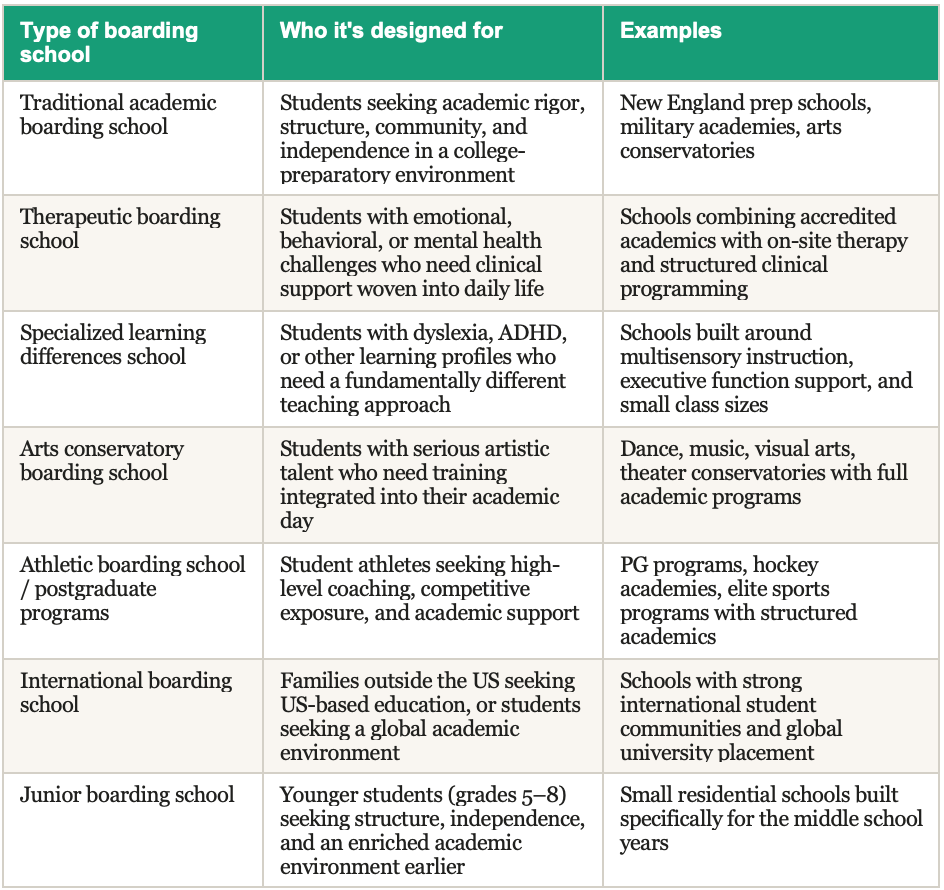
The important thing to understand is that these categories are not a hierarchy. A therapeutic boarding school is not a lesser option than a traditional one — it's a different option, designed for a different student. The question is never "which is better?" but "which is right for this child?"
Who boarding school is actually for — in 2026
The students I place in boarding schools are not a monolithic group. Let me describe the range, because it may surprise you.
The student who needs more than their current school can offer
This is perhaps the most common scenario I encounter. The student is not struggling clinically, they're fine, in many respects. But their current school, whether a local day school, a public school, or even a private school, simply cannot meet them where they are. The academic pace is wrong. The social environment is wrong. The culture doesn't fit who they are or who they're becoming.
For these students, boarding school isn't a drastic intervention, it's a match. The right environment for a student who has outgrown, or never fit, their current one.
The student who needs structure and community outside the home
Some students, and some families, are better served by the residential component of boarding school not because anything is wrong at home, but because the student needs a different kind of environment to develop. Independence, responsibility, consistent peer relationships, and adult mentorship that extends beyond the classroom. These are things that some students need and that boarding school provides naturally.
I've placed many students in boarding schools whose families were fully capable of supporting them at home. The question wasn't "can we provide this?" but "will this environment accelerate who our child is becoming?" In many cases, the answer was yes.
The student with a serious passion that needs to be central
For students who are serious about a creative or athletic pursuit ( who need their training integrated into their academic day rather than crammed into evenings and weekends) specialized boarding schools are often the only setting where they can develop at the level they're capable of without sacrificing their education.
Arts conservatory schools, athletic boarding programs, and postgraduate training programs exist precisely for these students, and the quality of training and mentorship available in these settings is genuinely different from what most day schools can offer.
The student with learning differences who needs a different approach
This is a category that remains underserved in most families' awareness. There are boarding schools built specifically around learning differences, schools where multisensory instruction, executive function support, and small class sizes are the norm, not the accommodation. For a student who has spent years working twice as hard for half the result in a standard school, these environments can be genuinely transformative.
The student who "finally gets it" in the right environment isn't the exception. I've seen it happen enough times to know it's the expected outcome when the match is right.
The student with emotional or behavioral challenges that need therapeutic support
This is a separate category, therapeutic boarding school, that I've covered more extensively in other resources. The short version: for students whose challenges require clinical support woven into their daily life, therapeutic boarding schools provide a level of integrated care that standard boarding schools are not equipped to offer. These are not placements of last resort; for the right student, they're the right first step.
How to know if boarding school might be right for your child
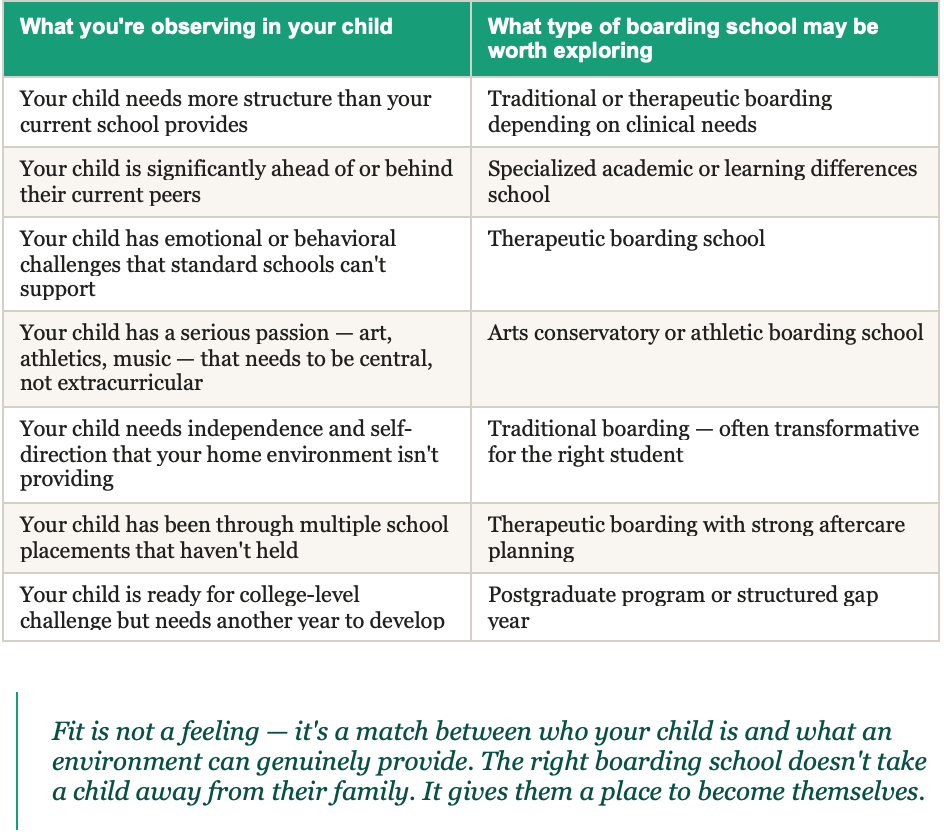
This is the question families most want answered, and the honest answer is: it depends on a thorough understanding of your child — their strengths, their challenges, their social and emotional profile, and what they actually need from an environment to grow.
That said, there are signals worth paying attention to:
What the admissions process actually looks like
One of the most common things I hear from families new to this process is that it feels opaque and intimidating. It doesn't have to be. Here is a clear picture of what the boarding school admissions process involves:
1. Assessment and list-building
Before a single application is submitted, the right process starts with a thorough understanding of your child — their academic profile, social-emotional needs, learning style, passions, and what they're looking for in an environment. This is where most families benefit from working with a consultant, because the number of schools and the nuance of fit decisions can be genuinely overwhelming without someone who knows the landscape well.
We build school lists based on fit, not prestige. A school that looks impressive on paper but doesn't align with who your child is will not produce the outcomes you're hoping for. A school you've never heard of that matches your child's profile precisely may change their trajectory.
2. Visits and interviews
Most boarding schools require a campus visit and student interview as part of the admissions process. These serve a dual purpose: the school is assessing the student, and the family is assessing the school. Both matter.
When visiting, pay attention to what you feel, not just what you see. How do the students interact with each other and with adults? What does the energy of the campus feel like? Does your child come alive during the visit or retreat? These observations carry more information than any tour guide script.
3. Applications and testing
Most boarding schools require the SSAT (Secondary School Admission Test) or ISEE (Independent School Entrance Examination), along with teacher recommendations, transcripts, and a student essay. The testing requirements and weighting vary significantly by school — and some therapeutic or specialized schools weight other factors far more heavily than standardized test scores.
The application itself — particularly the student essay — is an opportunity to present your child as a full person, not just an academic record. This is an area where preparation and guidance make a meaningful difference.
4. Financial aid and scholarships
This is the piece families often don't investigate because they assume boarding school is beyond reach financially. Many boarding schools have substantial financial aid programs — some offering need-based aid that covers a significant portion of tuition. The sticker price and the actual cost for your family can be very different.
If cost is a concern — and it's a legitimate concern — don't let that assumption close the door before you've looked at what's actually available. The first call is always worth making.
5. The decision
When acceptances come — and if the process has been done thoughtfully, they will come from schools that are genuine fits — the decision itself should feel different from the anxiety of the process. It should feel like choosing between real options, each of which has something genuine to offer your child.
If it doesn't feel that way, something in the list-building or visit process may have gone wrong — and it's worth pausing to understand what.
The questions families are afraid to ask
"What if my child doesn't want to go?"
This is more common than families realize, and it's a legitimate concern. Some students resist the idea of boarding school initially — out of fear of the unknown, reluctance to leave friends, or anxiety about a new environment. The resistance itself is not always a signal that boarding school is wrong.
What matters is the quality of the resistance. Is this a student who has genuinely considered it and has specific, articulable objections? Or is this anxiety and novelty aversion talking? These require different responses — and often, a student who was initially resistant becomes the one who says boarding school was the best decision of their life.
That said: we don't place students in environments against their will. The student's voice matters, and a good placement process includes them as a genuine participant.
"What if it doesn't work out?"
Boarding schools are not irreversible decisions. Students transfer from boarding schools every year — for all kinds of reasons, not all of them negative. A school that doesn't work in 9th grade may not be a match, and the family finds something better. That happens.
What reduces that risk is the quality of the placement process — understanding the student well enough before the decision to make a match that holds. This is why we spend as much time as we do on the front end. A thoughtful placement is far more likely to be a lasting one.
"Is my child ready?"
Readiness for boarding school is less about age and more about profile. Some 13-year-olds are genuinely ready for the independence that boarding school requires. Some 16-year-olds need more time. The question is not whether your child meets some generic standard of readiness, but whether the specific environment you're considering is designed for where your child actually is.
"Will my child feel abandoned?"
This is the fear that parents carry most quietly, and I want to address it directly. The research on boarding school outcomes — and my 30 years of watching these placements — suggests that the right boarding school placement doesn't damage the parent-child relationship. It often deepens it. Students who have space to develop their own identity, separate from the family dynamic, often return to those relationships with more capacity for genuine connection.
The families I've seen struggle most with this are those who chose boarding school for the wrong reasons — to solve a dynamic that needed a different solution. When the placement is right, the separation serves the relationship rather than harming it.
How we approach boarding school placement at Liston
We don't start with a list of schools. We start with your child.
Before any school research begins, we spend significant time understanding who your child is — their academic profile, their social and emotional needs, their passions, their learning style, and the dynamics within your family that are relevant to the decision. This takes time, and it should. The quality of that assessment is what makes the placement work.
We then build a list of schools based on genuine fit — not name recognition, not what the neighbors are doing, not what seemed to work for an older sibling. Each school on the list has a specific reason for being there that connects directly to something we know about your child.
We visit programs personally. We maintain relationships with admissions directors. We know the culture of these schools not from their websites but from walking their halls. That firsthand knowledge changes the recommendations we make.
And we stay involved through the process — through visits, applications, interviews, the decision, and the transition into the school — because the placement doesn't end when the acceptance letter arrives.
We don't measure success by the name of the school on the acceptance letter. We measure it by whether your child is, a year from now, in a place where they're genuinely growing, academically, emotionally, and as a person.
A final thought: the stigma that costs children their best option
I want to close with something I feel strongly about, because I've watched it play out too many times.
There is still, in many communities, a stigma around boarding school; a sense that choosing it means something is wrong with the family, or with the parent-child relationship, or with the child. This stigma is not based in reality, but it is real in its effects. It causes families to delay a decision that would have benefited their child years earlier. It causes students who would have thrived in a boarding school environment to spend years in the wrong place.
And on the other side: there is a prestige pressure that causes families to pursue the most well-known schools regardless of fit; to choose the name over the match. This is equally costly, because a prestigious school that doesn't fit your child will not produce the outcomes that a less well-known school with the right culture would.
Both errors share the same root: letting external reputation ( positive or negative ) drive a decision that should be driven by a deep, honest understanding of your child.
That understanding is something we can help you build. Whether boarding school turns out to be the right direction or not, the process of understanding your child well enough to answer that question is never wasted.
Wondering if boarding school is the right direction for your child?
Liston Education Group has been placing students in boarding schools, traditional, therapeutic, specialized, and everything in between, for more than 30 years. We know the landscape from the inside: the cultures, the admissions processes, the programs, and the outcomes.
We don't start with a list of schools. We start with your child, and build everything from there.
Reach out to start a conversation. No intake form, no pressure — just clarity about whether this direction makes sense for your family.
About the author
Jodi Liston is the founder of Liston Education Group, a concierge educational and therapeutic consulting firm. She has spent more than 30 years helping families navigate complex academic, emotional, and behavioral challenges — including traditional and therapeutic boarding school placement, school placement, special education advocacy, and crisis intervention. She came to this work in part through her own experience as a parent navigating these systems, and that experience shapes every family she works with.