
Failure to Launch: What It Really Is, Why It Happens, and How Families Can Help
There is a particular kind of heartbreak that comes with watching a capable, intelligent young person — someone you know has so much to offer — unable to take the next step.
They're not in school. They're not working. They're living at home, sleeping late, disappearing into screens, and reacting with anger or withdrawal every time you try to talk about the future. You've tried patience. You've tried pressure. You've tried ignoring it, hoping it would resolve on its own.
It hasn't.
"Failure to launch" has become the shorthand for this situation, and it's a phrase I hear from families every week. Sometimes with exhaustion. Sometimes with grief. Sometimes with a fear they won't say out loud — that this is just who their child is, and that nothing will change it.
I want to offer something different than that fear. Not false reassurance, but a clearer picture of what's actually happening — and why, for the right young person in the right kind of support, things can look very different.
"Failure to launch" isn't a character verdict. It's a description of a young person whose internal world hasn't caught up to the external demands being placed on them — and who needs something different than what they've had so far.”
First: let's reframe the term
"Failure to launch" is a useful shorthand, but it carries a weight that isn't always helpful. The word "failure" implies something went wrong with the person. In most of the cases I've worked with, that's not quite right.
What I typically see is a young adult — usually between 18 and 26, though sometimes older — who is caught between the expectations of adulthood and an internal world that isn't ready to meet them. The gap between what's expected and what they can currently manage has become too wide to bridge on their own.
That gap isn't laziness. It isn't bad character. It's usually the accumulated result of unaddressed anxiety, undiagnosed learning differences, depression, trauma, or simply a developmental timeline that doesn't match the cultural script of "graduate, get a job, move out."
Understanding this distinction matters, because it changes what families do next. If the problem is laziness, the solution is pressure. If the problem is something else — something clinical, something developmental, something structural — then pressure usually makes things worse.
What it actually looks like — and what's underneath
One of the things that makes this situation so hard to navigate is that it can look very different from the outside than it feels from the inside. What parents often experience as defiance or indifference is frequently something else entirely.
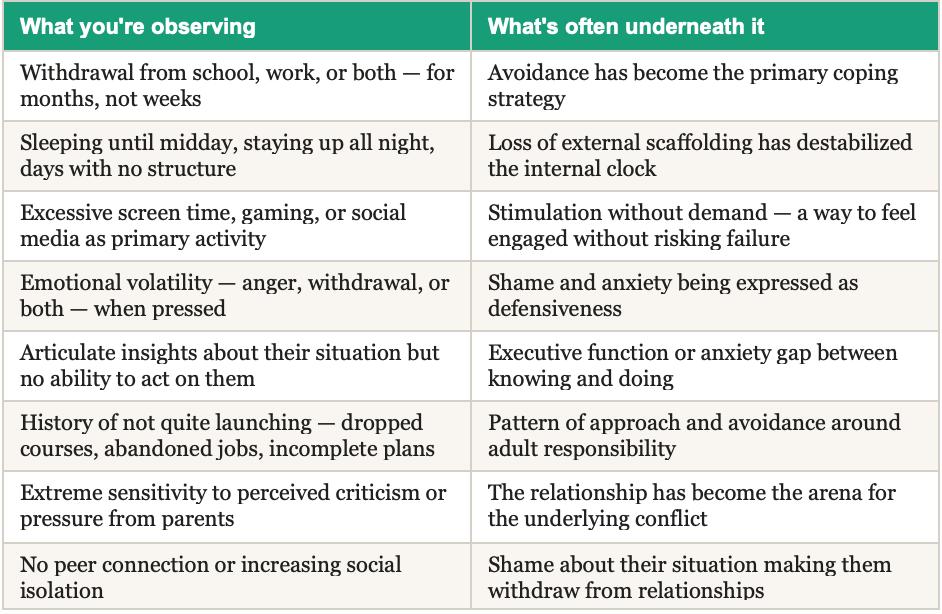
The common thread in almost every situation I've worked with is shame. These young adults are not, as a rule, content with where they are. Most of them are deeply aware of the gap between where they are and where they feel they should be — and that awareness is itself a source of paralysis. The shame of not launching makes launching harder.
Why it happens: the roots beneath the surface
There's rarely one single cause. What I've observed over decades of working with these families is that failure to launch is almost always the convergence of several factors — clinical, developmental, and relational.
Unaddressed anxiety
Anxiety is the most common underlying factor I see. And it's often anxiety that has been present for years — managed, compensated for, hidden — until the structure of high school ended and the scaffolding collapsed. Without external structure to organize their day and manage the unpredictability of adult life, anxiety that was previously contained becomes overwhelming.
For these young adults, the avoidance that looks like laziness is actually a symptom of anxiety doing what anxiety does: telling the nervous system to stay away from anything that might produce failure, judgment, or uncertainty. The problem is that adulthood is full of all three.
Depression
Depression doesn't always look like sadness. In young adults, it often presents as flatness, withdrawal, irritability, and a loss of motivation that can be easily misread as not caring. A young person who is depressed may sleep excessively, have no energy for things they used to find meaningful, and feel genuinely unable to imagine a future that's worth working toward.
Depression and failure to launch create a self-reinforcing loop: the isolation and purposelessness of not launching deepens the depression, which makes launching feel even more impossible.
Undiagnosed or undertreated learning differences
Some of the young adults I work with spent years in school managing a learning difference — ADHD, dyslexia, processing disorders — that was never properly identified or supported. They made it through high school on intelligence and workarounds, and then college or the workplace exposed the gap in ways they couldn't manage.
For these young adults, the experience of failure isn't new — it's the accumulated weight of years of working twice as hard for half the result, and finally running out of fuel.
Trauma — including trauma that doesn't look like trauma
Adverse childhood experiences, family instability, bullying, loss, social humiliation — these leave marks that aren't always visible. Some young adults who appear to be failing to launch are actually managing the ongoing effects of experiences that were never fully processed. The avoidance isn't about the future — it's a response to an internal world that feels unsafe.
The executive function gap
Executive function — the cognitive capacity to plan, initiate, organize, and follow through — develops throughout adolescence and into the mid-twenties. Some young adults, particularly those with ADHD or certain learning profiles, have executive function development that significantly lags their peers.
The result is a young person who can articulate what they need to do, understands why it matters, and genuinely wants to move forward — but cannot consistently initiate or sustain action. This is often mistaken for not caring. It's actually a neurological difference that responds well to specific kinds of support and structure.
The relational dynamic at home
This one is the hardest to name, but it matters. In some families, the dynamics between parent and young adult have become part of the problem — not because either party is at fault, but because the relationship has become the arena in which the young adult's ambivalence about independence plays out.
When every conversation about the future becomes a conflict, the young adult loses access to the parent as a source of support. The home becomes a place where they feel simultaneously dependent and defensive. This doesn't resolve with more pressure — it requires a different kind of engagement.
What families usually try first — and why it often doesn't work
Most families arrive at our door having already tried a number of things. Usually in this order:
1. Waiting it out
The first response is usually patience — giving the young adult time to "find themselves," trusting that motivation will come. For some young adults, this is the right call. For others, time without structure doesn't produce momentum. It produces more entrenchment.
The longer the pattern goes on, the harder it is to disrupt. Avoidance compounds. Social isolation deepens. The gap between the young adult and their peers widens, which increases shame, which increases avoidance. Waiting has a cost.
2. Applying pressure
When patience doesn't work, many families shift to pressure — ultimatums, deadlines, consequences. "You need to have a job by the end of the month." "We're not paying your phone bill anymore." "This can't continue."
Pressure sometimes works, briefly, for young adults whose situation is primarily about motivation. But for young adults whose situation is primarily about anxiety, depression, or clinical factors — pressure tends to produce one of two outcomes: an explosion of conflict, or a temporary compliance followed by collapse. Neither leads to the genuine, sustainable forward movement families are hoping for.
3. Therapy — without enough structure
Many families do the right thing and get their young adult into therapy. This is always worth doing. But weekly outpatient therapy, on its own, is often insufficient for young adults who are significantly stuck. An hour a week of insight-building doesn't create the daily structure, accountability, and skill development that moving forward requires.
Therapy is a necessary component — but usually not a sufficient one.
What actually helps
This is the part of the conversation families most want to get to — and the part where I always slow down. Because what helps depends enormously on what's actually driving the situation. Getting this assessment right is the difference between a path that works and one that doesn't.
That said, the approaches I've seen make the most consistent difference share several characteristics:
Structure that comes from the outside
Most failure-to-launch situations require external structure — a program, a schedule, a set of expectations that exists independently of the parent-child relationship. This takes the daily negotiation out of the family dynamic and puts it somewhere more neutral.
This might look like a therapeutic day program, a transitional living program, a structured gap year program, or a residential treatment setting, depending on the severity of the clinical picture. The key is that the structure is consistent, accountable, and therapeutic — not punitive.
Clinical support that matches the actual diagnosis
If anxiety is the primary driver, the treatment should target anxiety specifically — including the avoidance patterns that maintain it. If depression is the driver, that requires its own clinical approach. If there's an undiagnosed learning difference, identifying and treating it changes the picture entirely.
Generic "counseling" without a clear clinical framework often produces insight without momentum. The young adult understands themselves better but still can't act. What they need is targeted clinical work that addresses the specific mechanism keeping them stuck.
Executive function coaching and skill-building
Many young adults benefit significantly from practical, structured coaching in the skills that independent adult life requires: planning, task initiation, time management, financial literacy, communication. These aren't personality traits — they're skills that can be taught, practiced, and developed with the right support.
Reconnection with purpose and identity
One of the least-discussed but most important pieces is helping the young adult reconnect with a sense of who they are and what matters to them — separate from the pressure of what they're supposed to be doing. Many of these young people have spent so long in a posture of avoidance that they've lost touch with their own interests, values, and strengths.
Programs that build in meaningful work, community contribution, or skill exploration often provide this reconnection. When a young adult starts to experience themselves as capable and valuable in some context — even a small one — the internal narrative begins to shift.
A change in the parent-child dynamic
This is delicate, but it matters. The families who see the most lasting change are usually the ones who are willing to work on their own role in the dynamic — not because they caused the problem, but because the current pattern isn't working and something needs to be different.
This might involve parent coaching, family therapy, or simply a shift in the way conversations about the future are handled. Moving from "when are you going to do something" to "I trust that you're working through something difficult and I'm here when you're ready" is a significant change — and sometimes it's what finally opens a door.
The families who see the most lasting change are not always the ones who found the perfect program. They're the ones who got curious about what was actually happening — and were willing to try something genuinely different.
Programs that can help: what to look for
If you're at the point of considering a program or structured intervention, here is what I look for when evaluating options for families:
• Clinical credibility — licensed therapists on staff, evidence-based approaches, not just a "life skills" program with no therapeutic backbone
• Individualized assessment — programs that treat every young adult the same are not responding to the actual diversity of what drives failure to launch
• Structure with autonomy — enough structure to create accountability, but enough agency to build genuine self-direction rather than just compliance
• Family involvement — the home dynamic is part of the situation; programs that work only with the young adult and not the family often produce change that doesn't hold when they return home
• Aftercare planning — what happens after the program ends matters as much as what happens during it; a good program is building a sustainable path, not just a temporary solution
• Transparency — willingness to answer hard questions about outcomes, approach, and the specific needs of your young adult
Program types that are commonly appropriate for failure-to-launch situations include:
• Young adult residential treatment centers with a transitional living component
• Therapeutic gap year programs
• Structured transitional living programs with clinical support
• Intensive outpatient programs combined with supported housing
• Wilderness therapy programs designed for young adults (distinct from adolescent programs)
Not every young adult needs a residential program. Some respond well to intensive outpatient support combined with coaching and family work. The right level of intervention depends on the clinical picture, the level of impairment, and how long the situation has been going on.
This is exactly the kind of assessment we do with families — helping them understand what's actually driving the situation and what level of support is genuinely warranted.
A word to parents who are exhausted
If you've been living with this situation for months or years, I want to acknowledge something that doesn't get said enough: this is hard on you too.
The emotional weight of watching your child struggle — of loving them and being unable to help them — is its own kind of grief. The daily tension of navigating the relationship, the fear about the future, the isolation of not knowing who to talk to about this — these are real, and they matter.
Families who are supporting a young adult in this situation need support too. Not just information about programs, but someone who understands the complexity of this particular kind of parenting challenge — the way love and frustration coexist, the way hope and despair alternate, the way you can simultaneously believe in your child and be angry at them.
That's part of what we do. We're not just here to find your young adult the right program. We're here to think through this with you — as a family.
You don't have to have the answers. You don't have to have figured this out already. You just need someone who understands what you're dealing with and knows what questions to ask.
What we've learned from families who came through this
In more than 30 years of doing this work, I've watched many young adults who were deeply, seemingly permanently stuck find their way forward. Not always quickly. Not always smoothly. But forward.
What the successful situations had in common wasn't a particular program or a particular diagnosis. It was that the family — eventually, often after a lot of trial and error — found a way to understand what was actually happening rather than what it looked like from the outside. And then they found support that was designed for that actual situation, not for the situation they wished they were in.
"Failure to launch" is not a life sentence. It's a moment — a genuinely difficult one — that calls for a different kind of response than what has been tried so far. And for the right young adult in the right situation, what comes after it can be remarkable.
We've seen it happen. That's not reassurance — it's data.
Is your family navigating a failure-to-launch situation?
Liston Education Group works with families navigating young adult transitions — from early assessment through program placement, long-term case management, and family coaching. We help families understand what's actually driving the situation and identify the right level of support.
We work nationally, in person and remotely. We stay involved after placement — because the transition home matters as much as the program itself.
It’s just a conversation about your family and where things stand.
About the author
Jodi Liston is the founder of Liston Education Group, a concierge educational and therapeutic consulting firm. She has spent more than 30 years helping families navigate complex academic, emotional, and behavioral challenges — including young adult transitions, failure-to-launch situations, therapeutic program placement, school placement, and special education advocacy. She came to this work in part through her own experience as a parent navigating these systems, and that experience shapes every family she works with.