
When Your Child Says They Hate School: What It Means and What To Do
"I hate school."
Three words. Said at the dinner table, on the drive home, in a tearful Sunday-night meltdown, or muttered under their breath as they drag themselves to the car.
Every parent hears this at some point. And every parent has to make a split-second judgment call: is this just venting, or is this something I need to pay attention to?
After more than 30 years of working with families navigating academic and emotional challenges, I've sat with hundreds of parents who were trying to answer exactly that question — often after months of dismissing what turned out to be a real signal.
This guide is designed to help you tell the difference. Not with a checklist, but with the kind of nuanced, honest framework that actually helps families make good decisions.
"I hate school" is rarely just about school. It's often a child's best attempt to tell you that something isn't working — and they don't have better language for it yet.
Why this phrase is so hard to read
Part of what makes this so difficult is that the same words can mean completely different things depending on the child, the context, and the timing.
A ten-year-old saying "I hate school" after a hard test is almost certainly just processing frustration. A fifteen-year-old saying it every single morning, accompanied by stomach aches and a refusal to engage, is telling you something else entirely.
The challenge is that children — especially children who are struggling — often don't have the vocabulary to name what's actually happening. They can't always tell you "I feel invisible in this environment" or "the way I learn doesn't match how I'm being taught" or "I'm exhausted from pretending to be okay." So they reach for the words they have: I hate school.
Your job isn't to dismiss it or to panic. It's to get curious.
What it might actually mean
In my experience, "I hate school" tends to be pointing at one of several underlying realities. Understanding which one you're dealing with changes everything about how you respond.
1. The environment isn't the right fit
This is the most common root cause I encounter. The child is not struggling because something is wrong with them — they're struggling because the environment doesn't match who they are. The teaching style, the social dynamics, the academic pace, the culture of the school — something in the equation is off.
Children who are in the wrong environment often describe school as boring, pointless, or exhausting in a way they can't articulate. They may have been fine in earlier grades and gradually declined. They may perform differently at home or in activities they choose.
The key question to ask: does your child seem like a different person outside of school? Do they come alive on weekends in ways they don't during the week? That contrast is data.
2. Something social is happening
Social pain is some of the most intense pain a school-aged child can experience — and it's often the last thing they want to talk about directly. "I hate school" is frequently code for "I don't feel like I belong here" or "something is happening with my friendships that I don't know how to navigate."
This is especially true in the middle school years, when social identity is forming rapidly and peer dynamics can be genuinely destabilizing. A child who was thriving in elementary school may suddenly seem to fall apart at 11 or 12 — not because the academics changed, but because the social landscape did.
Watch for: changes in who they talk about (or stop talking about), reluctance to attend school events, vague complaints about "drama," or a sudden loss of interest in activities they used to do with friends.
3. There's a learning difference that hasn't been identified
A child who is working twice as hard as their classmates to produce half the output is going to hate school. Not because they're lazy — because it's genuinely exhausting to struggle in ways that feel invisible and unexplained.
Dyslexia, dyscalculia, dysgraphia, ADHD, auditory processing disorders — these conditions are often missed for years, particularly in children who are bright enough to compensate. They may be keeping up with grades but at enormous personal cost. They may be falling behind in specific areas while excelling in others.
Warning sign: a child who seems clearly intelligent but consistently underperforms in writing, reading, or math — or who takes significantly longer than expected to complete homework — deserves an evaluation.
4. There's an emotional or mental health challenge underneath
Anxiety, depression, and OCD in particular often show up first as school refusal or a generalized hatred of the school environment. The child isn't being difficult. They're managing an internal experience that makes the demands of a school day feel overwhelming — and they have no better way to tell you.
A child with unidentified anxiety may avoid school because it's a place where unpredictable things happen. A child who is depressed may describe school as pointless, exhausting, or suffocating. A child dealing with OCD may find the social and academic demands of school triggering in ways they can't explain.
These aren't character flaws. They're signs that the child needs support — and that the current environment may be making things harder rather than easier.
5. The relationship with a teacher or adult at school has broken down
Children spend an enormous amount of their day in relationship with adults they didn't choose. When that relationship goes wrong — when a child feels misunderstood, unfairly treated, or genuinely disliked by a teacher — the entire experience of school can become unbearable.
This is underreported because children are often afraid to name it directly. They may worry you won't believe them, or that speaking up will make things worse. Listen carefully for who they mention (or avoid mentioning) when talking about their day.
6. They're bored — and their school can't meet them where they are
Giftedness is its own kind of mismatch. A child who is significantly ahead of their peers may disengage not because they can't handle school, but because school can't handle them. Boredom at high levels of intelligence can look like defiance, distraction, or a generalized contempt for the academic environment.
If your child finishes work quickly, asks questions teachers find difficult, reads voraciously outside of school but refuses to engage with assigned reading, or seems to have more energy for learning in self-directed contexts — this may be what you're dealing with.
Normal developmental noise vs. a real signal: a quick reference
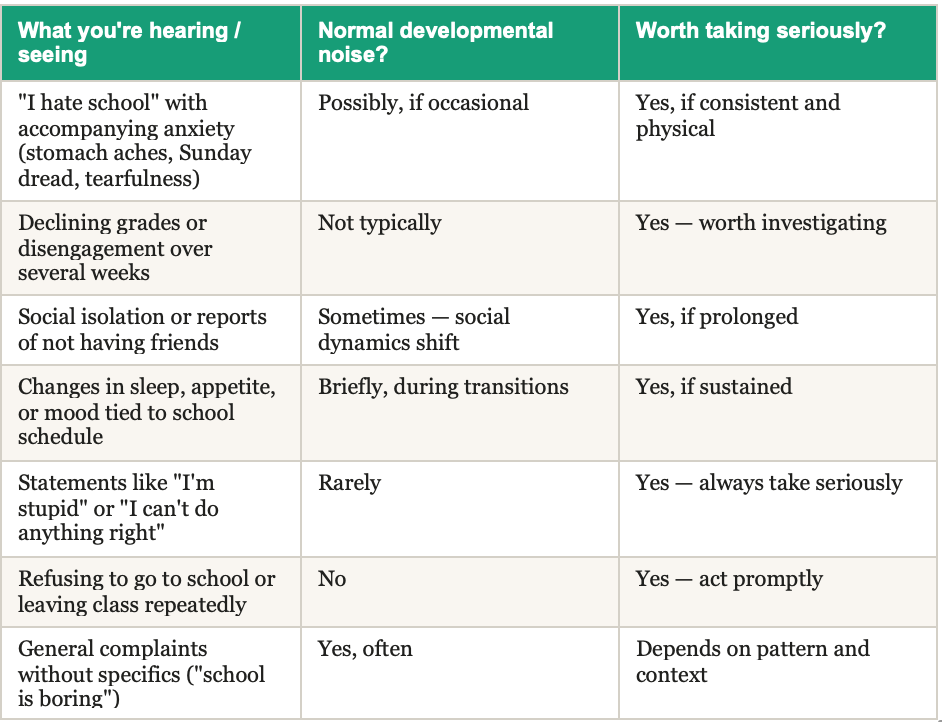
What not to do first
Before we talk about what to do, it's worth pausing on the responses that often make things worse — not because parents mean harm, but because they're natural reactions to a stressful situation.
Don't immediately dismiss it
"Everyone has bad days" is true. But a child who hears this repeatedly when they're trying to tell you something important will stop trying. Even if what's happening turns out to be relatively minor, treating it as worth investigating sends the message that you're paying attention.
Don't immediately catastrophize
The opposite error — going from "I hate school" to researching therapeutic boarding schools before the week is out — can overwhelm both you and your child. Most situations, when caught early, are navigable. The goal is to gather information before making decisions.
Don't make the school the adversary (yet)
Schools are not always right, and parents sometimes need to push back. But approaching the school as an adversary from the first conversation makes it harder to get the cooperation you actually need. Start from a position of partnership. Save the harder conversations for when they're necessary.
Don't try to solve it in a single conversation
Understanding what's underneath "I hate school" usually takes time. Multiple conversations. Observation. Sometimes professional assessment. Resist the pressure to arrive at a solution before you've properly understood the problem.
What to do — a step-by-step framework
1. Get curious before you get strategic
The first step isn't action — it's listening. Not to fix, not to reassure, but to genuinely understand. Ask open questions. "What's the hardest part of the day?" "Is there anyone at school you feel comfortable with?" "If you could change one thing about school, what would it be?"
Then listen to what they don't say as much as what they do. A child who goes quiet when you ask about a particular subject or person is telling you something. A child who lights up talking about lunch and goes flat talking about math class is giving you information.
2. Observe the pattern
Is this every day or some days? School-year only or year-round? Worse on Mondays (after the weekend break) or on specific days (test days, certain classes)? Morning only or all day?
Pattern recognition is one of the most useful tools a parent has. Once you can describe the pattern specifically, it becomes much easier to identify what's driving it — and what might help.
3. Talk to the school — carefully
Reach out to your child's teacher or school counselor not to report a problem, but to get information. "We've been noticing some resistance around school at home — I'd love to get your perspective on how things seem from your end." This opens a dialogue without putting anyone on the defensive.
Listen carefully to how the school responds. A teacher who says "your child seems fine" when your child is clearly not fine is telling you something about the communication you can expect. A teacher who says "actually, I've noticed some things too" is a potential ally.
4. Request an evaluation if learning differences are suspected
If you suspect a learning difference or disability is contributing — or if your child's academic performance doesn't match their apparent intelligence — you have the right to request a formal evaluation through the school, in writing. The school is legally required to respond.
An evaluation can clarify whether an IEP or 504 Plan is appropriate and often reveals things that change how you understand your child's experience entirely.
5. Seek a mental health assessment if warranted
If your child is showing signs of anxiety, depression, or significant emotional distress — particularly if it's affecting sleep, appetite, social connection, or their sense of self — a mental health evaluation is a valuable next step. A therapist who works with children and adolescents can help you understand what's happening and what kind of support would help.
Don't wait for a crisis to make this appointment. The earlier you have good clinical information, the more options you have.
6. Consider whether the environment itself needs to change
This is the step most families arrive at last — partly because it feels like a big decision, and partly because it's not always obvious that a different environment exists. But sometimes the most important thing a child needs isn't more support within the current school. It's a different school.
Day schools, boarding schools, therapeutic schools, specialized programs for learning differences, smaller alternative settings — the range of options is far wider than most families realize. And a child who has been struggling in one environment can look completely different in another.
Sometimes the issue isn't your child. It's the environment. A child who is labeled difficult, distracted, or behind in one school can become confident, engaged, and thriving in another. We've seen it happen hundreds of times.
When to bring in outside expertise
Most families can begin this process on their own. But there are situations where having an experienced consultant involved early changes the outcome significantly.
Consider reaching out to a consultant when:
• Your child's school is not responding to your concerns or is minimizing what you're observing
• You've tried multiple interventions and nothing is working
• The situation is escalating — school refusal, emotional crises, academic collapse
• You're beginning to consider a different school but don't know where to start
• Your child has complex needs that span both academic and emotional/behavioral areas
• You feel overwhelmed and need a knowledgeable, objective voice to help you think it through
We work with families at all stages of this process — from the earliest "something feels off" conversation to active crisis placement. You don't have to be at a breaking point to reach out.
A note on school refusal specifically
If your child has moved beyond "I hate school" to actively refusing to attend — whether through emotional meltdowns, physical symptoms, or simply not getting out of bed — this deserves its own attention.
School refusal (sometimes called school avoidance) is a recognized pattern that often involves anxiety, depression, or both. It's not a behavior problem. It's a sign that the internal cost of attending school has become too high for the child to manage.
The longer school refusal goes on, the harder it is to address — because avoidance tends to reinforce itself. A child who misses two weeks starts to feel behind. A child who feels behind becomes more anxious. More anxiety means more avoidance. The cycle is real, and it can move quickly.
If this is where you are: please don't wait it out and hope it resolves. It's worth getting clinical support, understanding the root cause, and making a plan. In some cases, that plan involves the current school with added support. In others, it involves a different environment entirely. The right answer depends on what's driving the avoidance — which is exactly what we help families figure out.
What we've learned from the families we've worked with
Over 30 years, I've seen this situation play out in hundreds of different ways. Some families catch it early and make a small adjustment that changes everything. Others come to us after years of struggle, having tried everything within the current school and reached the end of that road.
What I've learned is this: the families who navigate this best are not the ones who found the perfect answer immediately. They're the ones who stayed curious, kept listening, and were willing to challenge the assumption that the current environment was the only option.
"I hate school" is not a verdict on your child. It's information. And information, handled thoughtfully, is something you can work with.
The right environment doesn't just support a child — it reveals them. We've watched children who were labeled as problems become leaders, learners, and themselves, simply by finding the place where they finally made sense.
We're here when something feels off
If your child is struggling with school — whether you're at the early "something isn't right" stage or deeper into a crisis — Liston Education Group can help you understand what's happening and what your options are.
We work with families at every stage: assessment, advocacy, school placement, therapeutic program placement, and long-term case management. We don't let go after one conversation — we stay involved as long as you need us.
No pressure. Just a real conversation about your child and where things stand.
About the author
Jodi Liston is the founder of Liston Education Group, a concierge educational and therapeutic consulting firm. She has spent more than 30 years helping families navigate complex academic, emotional, and behavioral challenges — including school placement, special education advocacy, therapeutic program placement, and crisis intervention. She came to this work in part through her own experience as a parent navigating these systems, and that experience shapes every family she works with.