
After the Placement: Why What Happens Next Matters as Much as Where Your Child Goes
There is a moment that happens in almost every placement process, a moment families remember afterward as either a relief or a reckoning.
The acceptance letter arrives. Or the program confirms the enrollment date. And the consultant, who has been a steady presence through months of assessment, research, visits, and decision-making, sends a congratulations email and goes quiet.
For many families, this is when the real work begins. And they face it alone.
I've been in this field for more than 30 years. I've watched placements that looked perfect on paper fall apart in the first semester, not because the school was wrong, but because the transition wasn't supported. Because nobody was watching for the early warning signs. Because the family had nobody to call when things shifted, as they almost always do.
This is why, at Liston Education Group, we made a decision a long time ago: we don't let go after placement. Not after the first month. Not after the first year. Not until the family tells us they're ready.
This guide is my attempt to explain why that commitment matters, and what it actually looks like in practice.
The placement isn't the finish line. For most families, it's the starting line. What happens in the weeks and months that follow determines whether the investment, emotional, financial, and otherwise, actually holds.
Why placements fail, and when
Most placement failures don't happen because the wrong school was chosen. They happen because the transition period, the first 30 to 90 days, wasn't adequately supported.
Here's what that period typically looks like:
The honeymoon phase (weeks 1–3)
Almost every student arrives at a new school or program with some combination of hope and anxiety. The novelty of the environment, new people, new routines, new expectations, often produces a brief period of engagement that families and schools mistake for settling in.
This is the honeymoon. It's real, and it's also temporary. When it ends, usually around week three or four, is when the real adjustment begins. And that's when students who don't have adequate support start to struggle.
The reality sets in (weeks 3–8)
The environment is no longer new. The student is beginning to understand what the school actually expects of them, academically, socially, therapeutically. Patterns that existed before the placement start to re-emerge: avoidance, anxiety, conflict, disengagement.
This is the most vulnerable period. A student who hits this wall without adequate support, from the school, from the family, and from someone who knows the full picture of who they are and what they need, is at real risk of deciding the placement isn't working.
Sometimes it isn't working. More often, what's needed is not a different placement but a different level of engagement during the adjustment period. The difference between these two situations requires someone who knows the student, knows the school, and has the experience to distinguish between a bump and a genuine mismatch.
The mid-placement drift (months 3–6)
If the student makes it through the early adjustment, there's often a second period of vulnerability around months three to six, what I think of as the mid-placement drift.
The initial goals have been partially met. The student is managing, more or less. The urgency that brought the family to the placement has eased. And in that easing, something important can get lost: the ongoing clinical work, the family system adjustments, the preparation for what comes next.
Students who drift in this period often return home or transition to the next environment without the foundation that was supposed to be built during the placement. The placement "worked" in the sense that nothing catastrophic happened. But the transformation that was possible (and needed) didn't fully occur.
The transition home (month 6 onward)
The transition back home, or to the next placement, is frequently the most overlooked phase of the entire process. It requires as much planning and support as the original placement, and receives a fraction of the attention.
A student who returns home to the same environment, the same family dynamics, the same peer group, without a clear plan for how to sustain the progress made in their placement, is at significant risk of regression. Not because the placement failed, but because the aftercare did.
What most consultants do (and don't do) after placement
I want to be direct here, because families deserve honesty about what the consulting industry typically looks like.
Most educational consultants are paid for the placement process. Their fee structure, whether retainer-based or per-placement, is oriented around the work of finding and securing the right school or program. Once that work is complete, the engagement, formally or informally, tends to end.
This isn't negligence. It's a structural reality of how most consulting practices are built. The placement is the deliverable. What happens after the placement is, in most models, someone else's job, the school's, the therapist's, the family's.
The problem is that nobody else has the full picture. The school knows what's happening on campus. The therapist knows what's happening in sessions. The family knows what's happening at home. But the person who understands how all of these pieces connect; the consultant who did the original assessment, built the relationships, and knows why this placement was chosen is no longer in the room.
Nobody else has the full picture. The school knows the campus. The therapist knows the sessions. The family knows home. The consultant is the only person who holds all three, and most consultants step back the moment the placement is confirmed.
What Liston Education does differently, and why
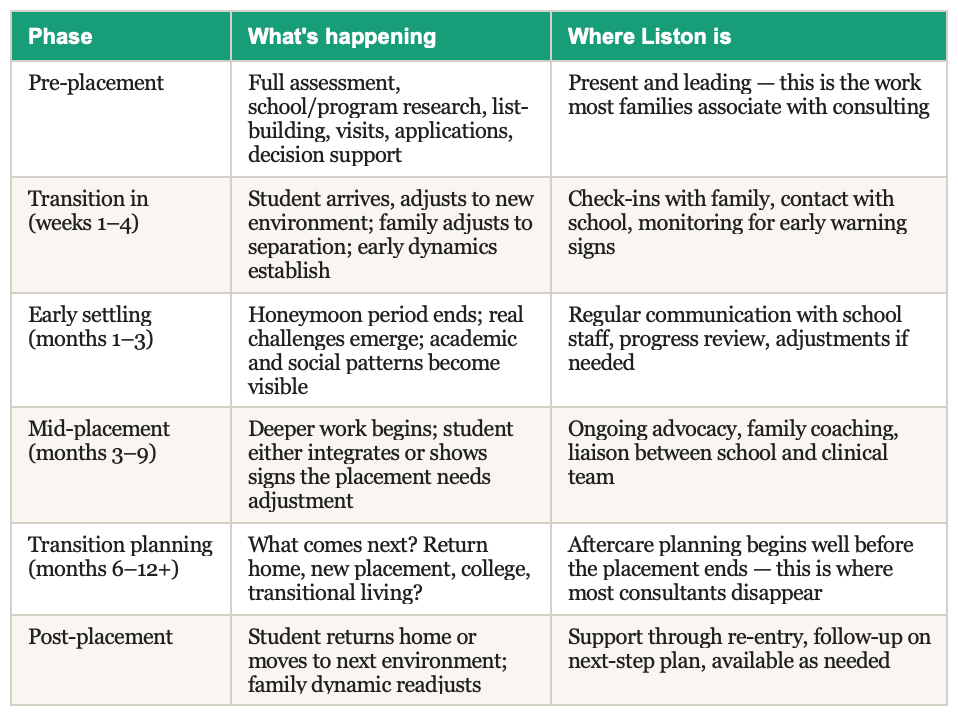
When we commit to working with a family, that commitment doesn't have a built-in end date. It continues through the placement, through the transition, and through whatever comes next; for as long as the family needs it.
Here is what that looks like in practice:
Regular contact with the school or program
We maintain active relationships with the schools and programs we place students in. We check in with staff not just at the beginning of a placement but throughout; formally at key milestones, informally when something warrants attention.
This matters because schools and programs are more candid with consultants they have ongoing relationships with. When a student is struggling in a way that isn't yet visible to the family, we often hear about it earlier, and can respond earlier, because we're a known and trusted presence rather than a distant name on an intake form.
Monitoring progress against the original goals
Every placement we make is grounded in a specific assessment of what the student needs and what success looks like for them. We don't lose sight of that assessment once the placement begins.
At regular intervals, we revisit the original goals: Is this placement producing what we hoped it would? Is the student making progress in the areas that brought them here? If the answers are mixed (if something is working but something else isn't) we want to know that early, not six months later when the options have narrowed.
Staying close to the family
Parents often feel a complicated mix of relief and anxiety once a placement is confirmed. The relief comes from having made a decision, from having a plan. The anxiety comes from the distance, from not being there, from not knowing what's happening day to day, from the uncertainty of whether they've made the right call.
We stay in regular contact with families throughout the placement not just to provide updates, but to remain a presence they can reach when something feels off. A parent who calls us at 7pm with a concern about something their child said in a phone call is a parent who deserves to be heard by someone who knows the full picture. That's us.
Adjusting the plan when things shift
Placements are not static. Students change. Programs change. What was the right environment six months ago may need to be reconsidered at twelve months. New clinical information may emerge that changes the trajectory. A student may be ready to move faster than expected, or may need more time than originally planned.
We stay involved in these adjustments. When a plan needs to change, we want to be in that conversation with the family, the school, and the clinical team, not called in after the fact to help pick up the pieces.
Aftercare and transition planning
The conversation about what happens after the placement begins well before the placement ends. Where is the student going next? What does the home environment need to look like in order to sustain the progress made? What ongoing support — therapeutic, academic, social — needs to be in place before the student transitions?
These are not questions that can be adequately addressed in the final weeks of a placement. They require months of intentional planning, ideally starting around the midpoint of the program. We lead this planning process, coordinate with the school and clinical team, and remain involved through the transition itself.
What this looks like for real families
I want to share a few examples, without identifying details, of what ongoing case management has meant for families we've worked with.
The placement that almost ended at week six
A family placed their 14-year-old daughter in a therapeutic boarding school after months of school refusal and escalating anxiety. The first weeks went well. By week six, she was calling home in tears, saying she wanted to leave, that the school didn't understand her, that she was miserable.
Because we were still involved, we were in contact with her treatment team within 24 hours. What we learned was that she had hit a therapeutic wall, a moment where the deeper work of the program had begun, and it was genuinely uncomfortable. This is not only normal; it's often a sign that the program is working.
We were able to hold that context for the family in a way they couldn't hold it for themselves, because they were scared, and fear makes it very hard to trust the process. We helped them understand what was happening. We supported them in staying the course. Eighteen months later, their daughter was a different person.
If we had stepped back at the point of placement, the family almost certainly would have pulled her at week six. The placement would have become another failed attempt. And she would have lost the environment that actually helped her.
The re-entry that needed a plan
A 17-year-old completed a year at a therapeutic boarding school and was preparing to return home for his senior year. He had made significant progress. His parents were cautiously optimistic.
We had been planning his re-entry for months. The local school needed to be prepared with appropriate supports. A therapist needed to be identified and engaged before he arrived home. The family needed coaching on how the dynamics at home would need to shift to support his continued growth.
Because all of that was in place before he walked through the door, his senior year worked. Not perfectly (nothing is perfect) but he graduated, went to college, and the progress held.
Without that re-entry planning, the regression we see in so many of these situations would have been very likely. The work of the placement would have been partially undone by an unsupported transition home.
The family that needed someone in their corner
A family whose son was in a therapeutic program reached out to us eight months into the placement. The program was recommending an extension - another six months beyond the original plan. The family wasn't sure whether this was the right call or whether the program was simply extending their revenue.
Because we knew the student, knew the program, and had maintained relationships with both throughout the placement, we were able to have an honest conversation with the clinical team and make an independent assessment. Our conclusion: the extension was warranted, but a specific set of goals needed to be established for that period, with a clear transition plan attached.
The family needed someone who could advocate for their son's interests with informed judgment, not just rubber-stamp the program's recommendation, and not dismiss it out of cost concerns. That's exactly what ongoing involvement allows us to do.
What to ask any consultant about their post-placement involvement
If you are evaluating educational or therapeutic consultants, whether you're considering Liston Education or any other firm, here are the questions I would ask directly:
• What does your involvement look like after the placement is confirmed?
• How often do you communicate with the school or program during the placement?
• Who do I call if something changes during the placement, and how quickly will I hear back?
• Do you charge separately for ongoing case management, or is post-placement support included?
• At what point do you consider your work with a family complete?
• Can you describe what you did for a family during the transition back home or to the next placement?
The answers to these questions will tell you a great deal about what the relationship will actually look like, and whether the consultant sees the placement as the end of their work or the beginning of it.
A commitment, not a feature
I want to be clear about why we work this way, because I don't want it to sound like a sales point.
We work this way because we've seen what happens when families are left on their own after placement. We've seen placements that should have held fall apart because nobody was watching. We've seen students return home without the support they needed. We've seen families make decisions in panic that a single informed conversation would have changed.
We also work this way because the families who come to us are trusting us with something irreplaceable, their child's wellbeing, and their own. That trust doesn't expire when the acceptance letter arrives. It continues as long as the child is navigating the path we helped build.
Staying involved is not a service we offer. It's an expression of what we believe a genuine partnership with a family actually means.
You deserve a consultant who is still there six months later. Who knows your child's name and their story and what the original goals were. Who you can call on a Tuesday evening when something feels off. That's what we commit to — not because it's good business, but because it's the right way to do this work.
Looking for support that doesn't stop at placement?
Liston Education Group provides long-term case management alongside our placement work, staying involved through transitions, monitoring progress, coordinating with schools and clinical teams, and planning for what comes next.
We work with families at every stage: from the earliest "something feels off" conversation through placement, transition, and beyond. We work nationally, in person and remotely.
Reach out to start a conversation. An honest discussion about your family and where things stand.
About the author
Jodi Liston is the founder of Liston Education Group, a concierge educational and therapeutic consulting firm. She has spent more than 30 years helping families navigate complex academic, emotional, and behavioral challenges, including therapeutic placement, school placement, long-term case management, special education advocacy, and crisis intervention. She came to this work in part through her own experience as a parent navigating these systems, and that experience shapes every family she works with.